
Crete's Wasted Advantage: A Case for a Mediterranean Transhipment Hub
Opportunity in Crete
While Crete expands its hotel infrastructure, container ships laden with billions in cargo sail past offshore. The island’s economy continues to hinge on a six-month cycle: tourists arrive in summer, revenue flows, and then winter descends, bringing joblessness in its wake. Meanwhile, some of the world’s largest vessels travel between the Suez Canal and European ports, bypassing an island that is ideally situated to serve them.
Greece already hosts the Port of Piraeus, one of Europe’s most important ports, situated on the mainland near Athens. It manages vast volumes of Asia–Europe trade. Yet success has bred its own challenges. Piraeus is now congested, increasingly costly, and under pressure from vessels it was never designed to accommodate at this scale. Ships often wait days for a berth; costs escalate, and efficiency declines. What was once a model of speed and reliability no longer delivers either consistently.
Crete has the opportunity to alleviate this burden. More importantly, it could reinvent its own economy. The island offers what container shipping prioritises, namely natural deep harbours, strategic proximity to the Suez Canal, and underutilised maritime capacity. What it lacks is infrastructure investment and the political resolve to contest the mainland’s entrenched economic and demographic dominance.
The Case for Souda Bay
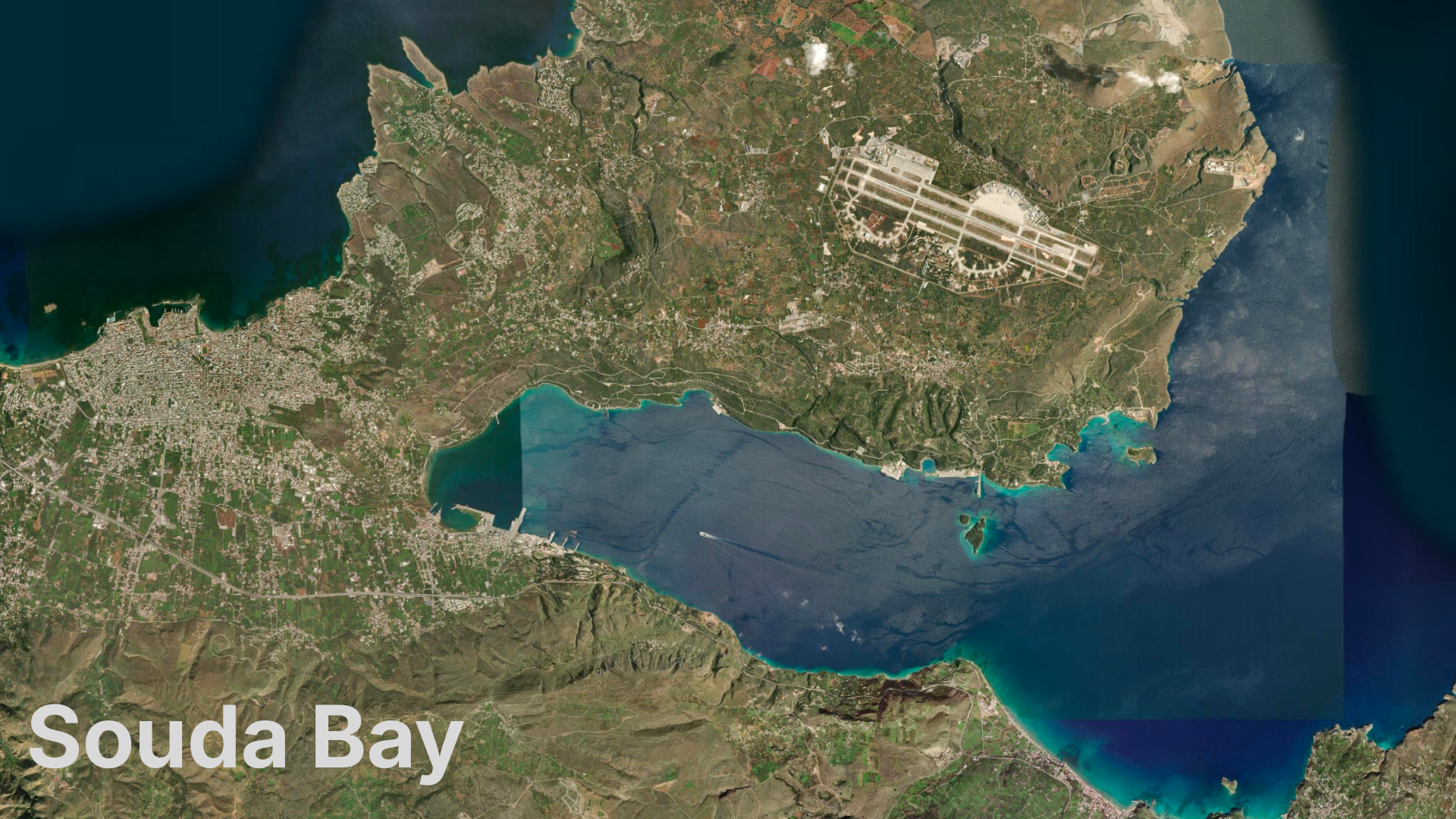
Of all potential sites, Souda Bay presents the strongest case. Deep and naturally protected, it can accommodate large container vessels without the costly dredging required elsewhere; geography has already done much of the hard work. While the bay currently hosts Greek and NATO naval installations, posing a coordination challenge, this is not unprecedented. Major ports worldwide, from Djibouti to San Diego, operate civilian terminals alongside military facilities.
Recent proposals to develop a green port and transhipment capacity near Heraklion reflect growing recognition of Crete’s logistical potential, but they also highlight the trade-offs involved in site selection. The complexity at Souda is real, but far from insurmountable. Choosing an inferior location to avoid that complexity would risk trading strategic and geographical advantage for administrative convenience.
The economic logic is compelling. Ships travelling from Asia through the Suez Canal reach Crete before Piraeus. In container shipping, time is capital. Each day saved translates into reduced fuel consumption and less capital immobilised at sea. If Souda Bay can provide berths without lengthy delays now common at Piraeus, shippers are likely to redirect traffic, offsetting the premium paid for speed and predictability.
Crete would not go unchallenged, as Ankara continues to build formidable transhipment hubs across Turkey’s coasts. Malta leverages its geography and EU membership for similar aims. Egypt is investing heavily in logistics zones to capitalise on its Suez adjacency. Yet Crete holds advantages its rivals lack. Unlike Turkey, it offers seamless EU customs integration, which is crucial for European-bound cargo. Unlike Egypt, it provides political stability and a mature legal framework. Unlike Malta, it has the land and space to develop port infrastructure at substantial scale. This is not just a hypothetical opportunity; it is one awaiting execution.
Air cargo adds a complementary, though secondary, dimension. The new Heraklion Airport, centrally located and with ample runway capacity, could support regional freight operations by breaking bulk from maritime shipments and distributing goods by air across the Mediterranean and North Africa. Many global shippers operate both sea and air freight networks. Offering both within a single logistics node only strengthens the island’s appeal.
This development would redefine employment in Crete. Tourism and agriculture generate seasonal jobs; logistics offers year-round, skilled positions. Port operations demand crane operators, logistics managers, and customs brokers. Air freight requires ground crews, technicians, and dispatchers. Warehousing requires inventory specialists, quality control staff, and distribution planners. These are middle-income careers with prospects, benefits, and permanence that far exceed the precariousness of the hospitality sector. The ripple effects would extend to trucking, freight forwarding, finance, and cargo IT systems. This represents large-scale economic diversification.
Realising this vision would demand capital and strategic partnerships. Transforming Souda Bay into a global container terminal would require billions in investment for cranes, container yards, and digital port systems. In competition with the facility proposed and under development at the Port of Heraklion, success would lie in attracting a global terminal operator such as APM Terminals, MSC, or CMA CGM, which can provide both capital and operational expertise. Alternatively, it could involve attracting foreign governments, notably the United States, which has shown interest investing in Greece’s port systems as part of broader efforts to diversify away from COSCO.
Bureaucratic Resistance
Political resistance may outweigh the financial challenges. Stakeholders in Piraeus will likely oppose a rival port that threatens their throughput. Developments at Heraklion may also complicate matters. Crete is Greece’s largest island, but it remains a finite market, raising the question of whether two transhipment ports could be sustained simultaneously.
Athens’ bureaucracy is notoriously slow, and a national economic strategy that has long centralised power in the capital may not welcome decentralisation. For decades, “regional development” has meant channelling resources through Athens. Building Crete, via Souda Bay or Heraklion, into an autonomous logistics hub would disrupt the current paradigm. The question remains whether Greek leadership can transcend zero-sum thinking and recognise that a more prosperous Crete strengthens the nation as a whole.
The alternative is familiar. Crete remains reliant on a fragile tourism economy, vulnerable to global shocks. Its educated youth continue to emigrate in search of year-round employment. Container ships continue to sail past, and Souda Bay remains one of the best natural harbours in the Eastern Mediterranean, underused and underdeveloped, requiring coordination and political capital that may not materialise.
Geography is indifferent to policy. Souda Bay will remain a premier deep-water harbour, and better suited than Heraklion to serve as a transhipment hub, whether Athens chooses to utilise it or not. The vessels, and the economic benefits they carry, will continue to sail past. The only question is how long Athens will allow Crete to watch opportunity drift by before deciding to act.