
Greece Is Not an Energy State but an Energy Gate
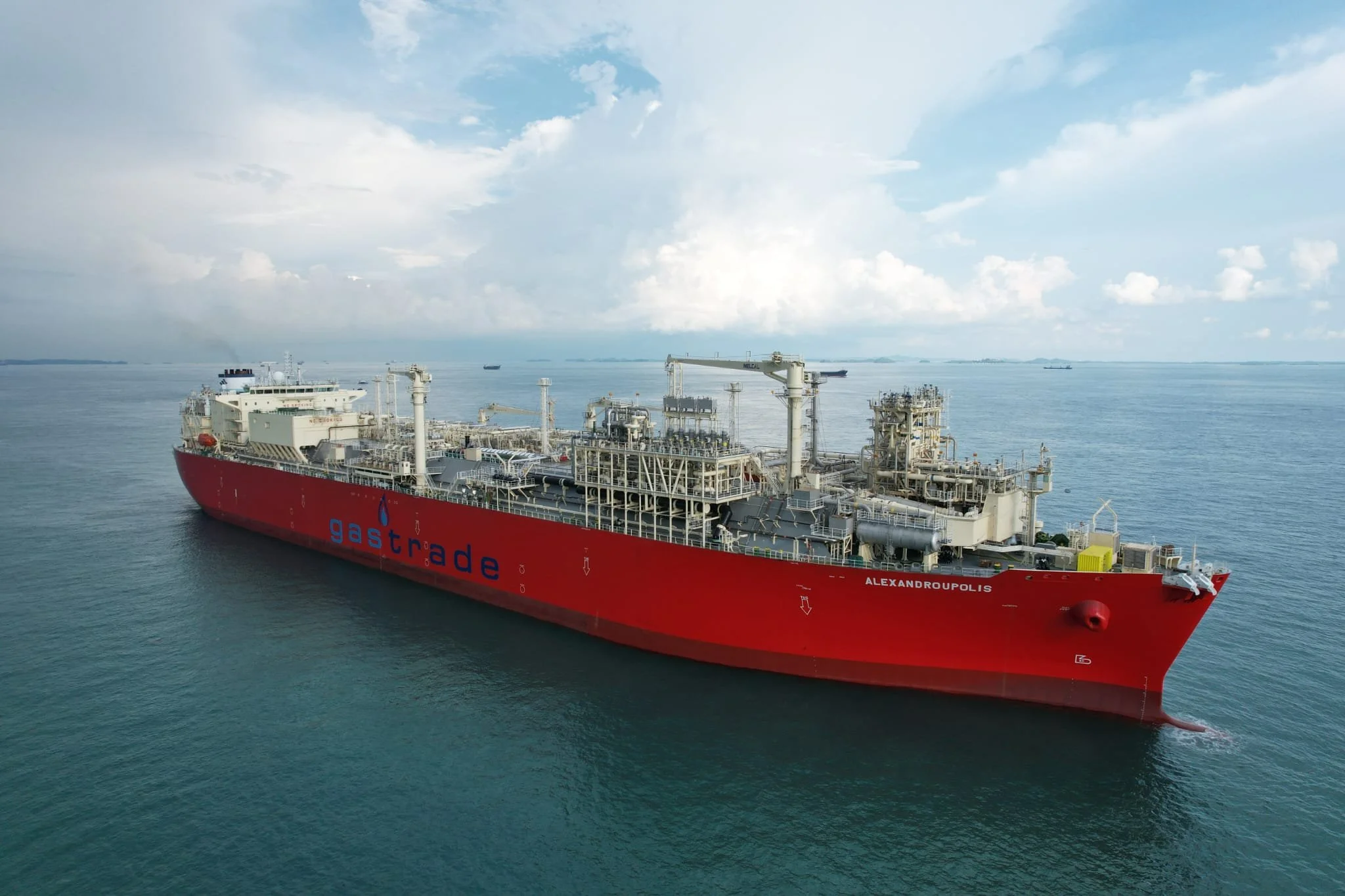
Photo: Gastrade
Greece is not an energy state. It does not command large hydrocarbon reserves, it does not influence global pricing, and it does not shape production cycles. Yet this framing misses the nature of power in contemporary energy systems. Strategic relevance today is derived less from extraction than from position and from the ability to enable, constrain, or redirect flows. In this respect, Greece occupies a role that far exceeds its production profile. Situated at the convergence of maritime routes, regional markets, and emerging infrastructure bottlenecks, Greece does not supply energy to Europe so much as it conditions the terms under which energy reaches it.
This role has become increasingly visible with the transformation of liquefied natural gas from a market commodity into a strategic instrument. LNG is maritime by design. It depends on ports, terminals, shipping lanes, and storage capacity rather than fixed geography. Infrastructure such as the Revithoussa LNG Terminal and Alexandroupolis FSRU has quietly repositioned Greece from the margins of European energy planning towards its logistical centre. These facilities do not generate energy, but they shape access, timing, and resilience, particularly for South-Eastern Europe and the Balkans. In an environment defined less by abundance than by reliability, this distinction is decisive.
The shock to Europe’s energy system after 2022 is now well understood and requires little restating. What mattered was not the interruption itself, but the structural reordering that followed. LNG shifted from a supplementary supply into the primary mechanism through which European states sought resilience. The shift favoured countries able to absorb volatility, with access to ports, flexible storage, and maritime connectivity, rather than those built around pipelines. In this reconfigured landscape, the distinction between producers and enablers became more consequential than ever.
Nowhere was this more apparent than in South-Eastern Europe. Unlike much of Western Europe, which could rely on diversified terminals, deep storage, and established internal distribution networks, the Balkans entered the period with limited redundancy and high exposure to single-route dependencies. This created both vulnerability and opportunity. Greece’s position at the maritime edge of the region, combined with its proximity to emerging LNG infrastructure, placed it in a uniquely advantageous role. While Western European states focused on balancing volumes, Greece found itself shaping access and acting as an entry point through which energy security for neighbouring markets could be stabilised, or constrained, by logistics rather than politics.
By the mid-2020s, the scale of American LNG output had reached levels that fundamentally altered transatlantic energy flows. US liquefaction capacity rose from roughly 70 million tonnes per annum in 2021 to over 95 million tonnes by 2024, with additional capacity already contracted. In volume terms, this translated into more than 85 million tonnes of LNG exported annually, making the United States the world’s largest LNG exporter. Europe absorbed the majority of this increase. In value terms, US LNG exports to European markets alone exceeded 35-40 billion per year, depending on pricing conditions. These were not marginal flows. They were system-shaping volumes, arriving on fixed shipping schedules and requiring immediate absorption.
The imbalance between export capacity and European intake capability underpinned the 2025 decision to formalise Greece’s role as a regional LNG absorption hub. Greek regasification capacity, combining existing onshore terminals and floating storage and regasification units, approached 10 billion cubic metres annually, with expansion plans pushing this figure higher. While modest compared to Western Europe giants, this capacity was disproportionately significant for South-Eastern Europe, where annual gas demand across multiple states combined often falls below that threshold. Greece’s terminals were therefore capable of handling not only domestic consumption, but surplus volumes intended for onward transmissions into the Balkans. In practical terms, Greece could absorb a meaningful share of marginal US LNG flows during peak delivery periods, reducing congestion elsewhere in the European system.
The financial logic reinforced this arrangement. LNG carriers operating on transatlantic routes represent capital assets valued at USD 230-260 million per vessel, with daily charter rates that can exceed USD 150,000 during periods of tight supply. Delays at congested terminals impose real costs, not just in demurrage but in disrupted delivery chains. Greek infrastructure offered schedule flexibility. Cargoes could be discharged, stored, and re-routed with fewer delays, effectively converting fixed American export output into flexible European supply. This is the operational meaning behind the “LNG sponge” designation. Greece does not absorb energy for consumption alone. It also absorbs timing risk, price volatility, and logistical pressure on behalf of the wider system.
This infrastructure build-out extends beyond a single terminal or location. In addition to the Alexandroupolis FSRU, Greece has advanced multiple LNG-related projects designed to distribute risk geographically and operationally. The planned FSRU at Dioryga Gas is intended to serve southern and central markets, while proposals linked to Thessaloniki LNG Terminal and the Argo LNG FSRU near Volos focus on reinforcing northern supply routes into the Balkans. Taken together, these developments could raise Greece’s total regasification capacity well beyond 15 billion cubic metres annually, a level that exceeds domestic demand and confirms an export-oriented logistics role.
The economic implications of this expansion are material but often understated. LNG terminals and associated port infrastructure generate relatively few permanent jobs in absolute terms, yet they are disproportionately concentrated in high-skill, high-wage categories. Engineering, maritime operations, cryogenic systems maintenance, grid integration, and port services all require specialised labour that cannot be rapidly substituted. Construction phases typically involve several thousand workers across multi-year timelines, while operational facilities sustain smaller but stable cohorts of technicians, mariners, and system operators. Precisely because these roles are technically demanding, they expose a constraint as much as an opportunity. Competence in LNG operations is accumulated over years rather than trained on demand, creating a structural lag between infrastructure deployment and human capability. One response is to treat skills acquisition as a transnational process rather than a domestic bottleneck. Structured labour exchange arrangements with established LNG operators, particularly in the Gulf, could accelerate capability development without compromising safety or operational standards. A relevant precedent exists. In the United States. Shipyard labour development has included overseas placements through partnerships involving Hanwha Ocean, where American workers were embedded within South Korean yards to acquire complex industrial skills before returning home. A comparable model, linking Greek technicians and port specialists with LNG-intensive environments such as Qatar, would shorten learning curves while anchoring expertise domestically over the long term. This is not workforce outsourcing. It is capability importation.
What emerges from this pattern of investment is a model that prioritises competence over scale. Greece is not pursuing LNG infrastructure as a broad employment engine, nor as a symbolic assertion of energy independence. Instead, it is building systems that reward reliability, technical proficiency, and integration into international supply chains. This approach closely mirrors Greece’s wider maritime profile: capital-intensive, skill-dependent, and outward-facing. The economic value lies not in volume alone, but in indispensability.
Greece’s emerging role in the LNG system is therefore neither accidental nor transformative in the traditional sense. It does not confer control over energy markets, nor does it insulate the country from external shocks. What it does provide is relevance. By positioning itself as a logistical gate rather than a producer, Greece has embedded itself within the mechanics of transatlantic energy flows at a moment when reliability, timing, and access matter more than abundance. This role carries exposure as well as opportunity. It binds domestic infrastructure and labour decisions to external production cycles and global demand shifts beyond Greece’s control. Yet in a system increasingly defined by volatility, the ability to absorb pressure, rather than generate supply, may prove to be a quieter and more durable form of strategic power.